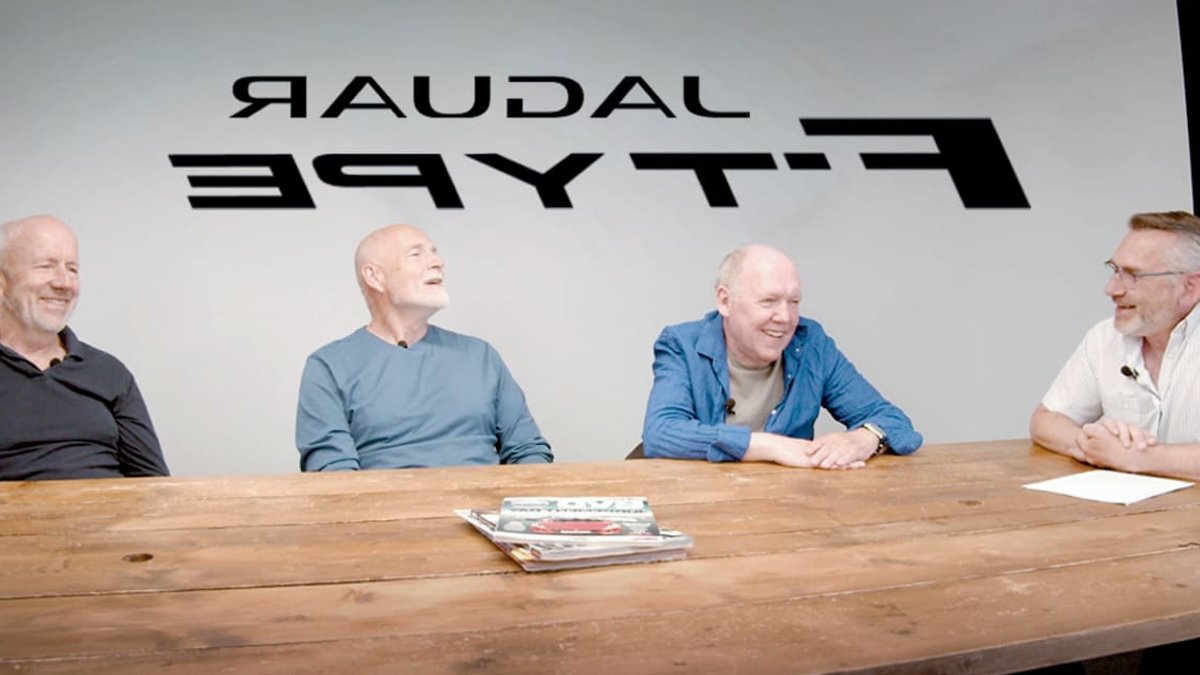
It took nearly four decades for Jaguar to replace the iconic E-type. After the original model ended production in the mid-1970s, internal discussions about a successor began immediately. The project nearly moved forward in the 1980s, but various factors stalled progress. Following Ford’s acquisition in 1989, the concept was reworked and eventually became the Aston Martin DB7. Jaguar’s ownership shifted again in 2008 when Tata Motors took over, bringing a car enthusiast to the helm.
The new leadership opened doors for design director Ian Callum, chief programme engineer Russ Varney, and vehicle integrity chief Mike Cross. One result was X152, the new F-type. I was involved too, having unexpectedly found myself out of a job at evo. By chance, Mike Cross was looking to add to his team of vehicle assessors because development of the hybrid supercar, C‑X75, was about to kick off. Ultimately C‑X75 didn’t make it to production but there was plenty to do on C‑X16, the sports car concept shown at Frankfurt in 2011 that would become the X152, aka the F-type.
Related: Cadillac takes on BMW M5 with CT5
John Barker: Ford sold Jaguar to Tata in 2008. Did that seem like an opportunity to do more stuff, more interesting stuff? Ian Callum: Yeah, I think it did. We had the ear and the attention of Mr Tata himself, and although he was primarily focused on Land Rover, he suddenly realised there’s a sports car company here and he wanted to get more involved. We used to see him regularly, and he loved cars. He was instrumental in a lot that happened. And if you got him on your side, which wasn’t difficult, he would endorse things quite quickly.
JB: C‑X75 was first. Was it a show car, a concept? IC: Purely. It wasn’t intended for production. Julian Thomson and I decided we wanted to rattle things a bit. We thought there’s an opportunity to show off to Tata, we could do something really special. So we developed this one-off car with would-be turbine-charging motors on it, and it was a nice idea. It caught the imagination of a lot of people at Paris in 2010.
Related: Beckton Beauty: A Guide to Personalized Engagement Rings
JB: Then came C‑X16, which was actually the finished F-type coupe. IC: We’d done the C‑XF years before and the design team went a bit wild on it, chopped the roof and put huge wheels on it, slimmed the lights… and we shot ourselves in the foot a little because when we brought out XF, the great new future of Jaguar, they kind of went ‘Oh…’. I learned the hard way you cannot over-promise on the concept cars. C‑X75 was different because it was a one-off. C‑X16, I said to the team, we’ve got to just temper this so that we don’t over-promise. But we did put the side opening [rear] door on it, like an E-type, which was a lot of fun.
JB: C‑X16 was intended for production. Russ Varney: Well, we knew it would package, we knew that the design was feasible, and that made it actually easier for us to progress. Really, what Ian had done was the real car.
Related: Updated 2027 XPeng G6 electric SUV lands in Australia
JB: There had been some benchmarking, creating a ‘statement of intent’? Mike Cross: Back then there was a ‘Jaguar DNA’, which described how all Jaguars should drive, and we changed the flavour depending on whether it was a sports car, a saloon or whatever. We looked at the competition as well, worked with sales and marketing, and then tried to define all that in a document that everybody in the company could see, which described how the car should drive and behave.
JB: It was quite shrewd because although it was launched in Frankfurt, which was pretty bold, it wasn’t aimed at a particular Porsche. In price, the 911 was above, the Boxster was below. MC: I think there’s sometimes an assumptio


