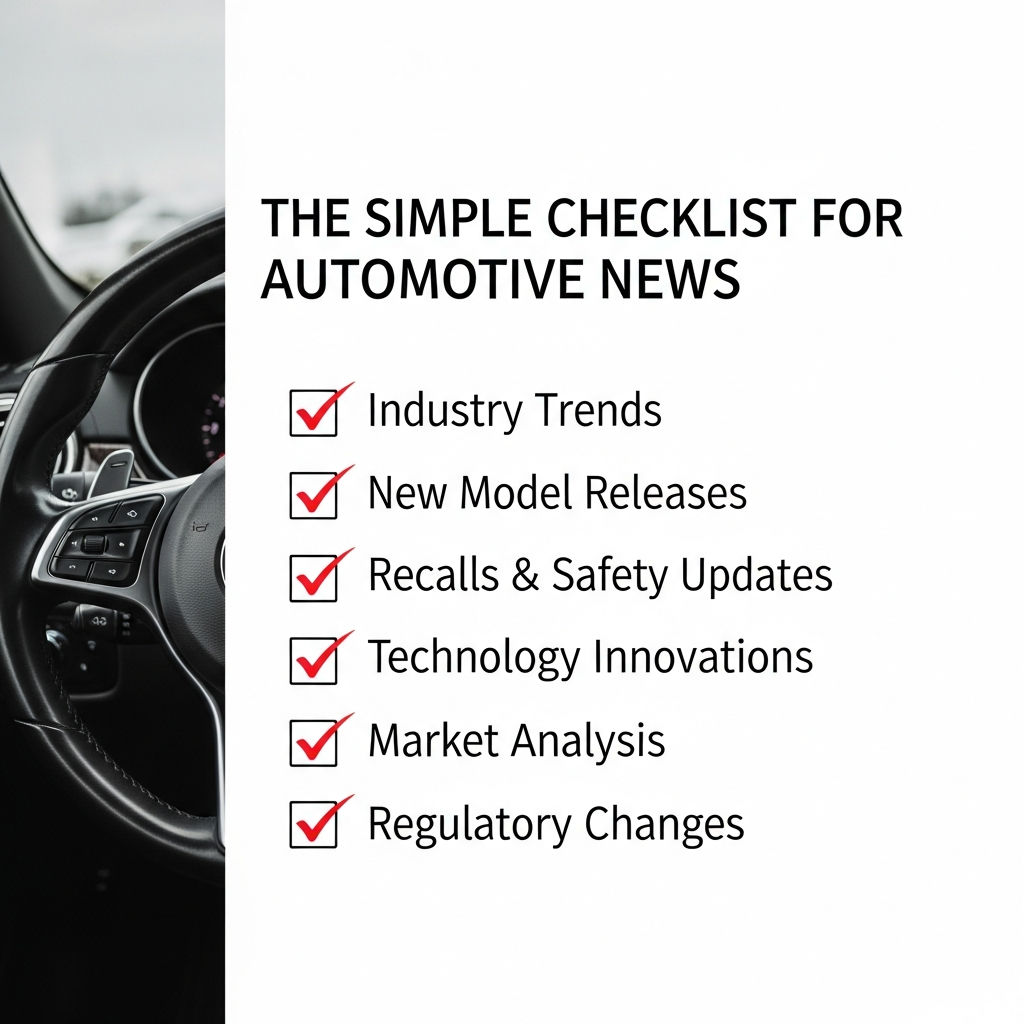
The Ultimate Checklist for Automotive News: How to Write High-Performance Car Stories
The automotive industry moves at breakneck speed. From the sudden reveal of a revolutionary electric vehicle (EV) to the breaking news of a major manufacturer merger, staying ahead of the curve is a challenge for any journalist or content creator. In an era where information is decentralized, providing value in automotive news requires more than just being first; it requires accuracy, depth, and a strategic approach to SEO.
Whether you are managing a high-traffic car blog or a niche automotive news site, consistency is key. To ensure every piece of content you publish drives engagement and ranks on search engines, you need a reliable framework. This is the simple checklist for automotive news that will help you transition from a casual reporter to a dominant voice in the industry.
1. Verify Technical Specifications and Accuracy
The foundation of any reputable automotive news story is technical accuracy. Car enthusiasts are notorious for noticing even the slightest error in a spec sheet. Before hitting publish, ensure you have double-checked the following:
- Powertrain Details: Is it a biturbo V6 or a naturally aspirated one? What is the exact kilowatt-hour (kWh) capacity of the battery?
- Performance Figures: Verify 0-60 mph times, top speeds, and torque figures. Always specify if these are manufacturer estimates or independent test results.
- Pricing and Trim Levels: Clearly state the MSRP and note whether it includes destination charges. If the news covers a global release, ensure you have converted currencies or specified the market (e.g., USD for North America, EUR for Europe).
- Release Dates: Distinguish between the “reveal date,” the “order bank opening,” and the actual “dealership arrival.”
2. Optimize for Visual Impact
Automotive news is inherently visual. Readers want to see the lines of a new chassis, the texture of the interior leather, and the interface of the infotainment system. High-quality imagery is not just a luxury; it is a requirement for modern SEO and user retention.
High-Resolution Imagery
Always use high-resolution press photos provided by the manufacturer. Avoid using blurry screenshots from reveal videos. Ensure that you have a mix of exterior shots (front three-quarters, rear, and profile) and interior details (dashboard, steering wheel, and rear seating).
Video Integration
If there is an official reveal trailer or a walk-around video, embed it. Video increases the “dwell time” on your page, which is a significant ranking factor for Google. It also provides a richer experience for users who prefer watching over reading.
Image Alt Text
From an SEO perspective, your images must be findable. Use descriptive alt text such as “2025 Porsche 911 GT3 front fascia in Shark Blue” rather than generic names like “car-front.jpg.”
3. Provide Context and Industry Analysis
Regurgitating a press release is not “news”—it’s stenography. To stand out, your article must provide context. Why does this specific car matter? How does it change the landscape of its segment?
- The Competitive Set: Compare the new model to its direct rivals. If you are reporting on a new electric SUV, mention how its range and price point compare to the Tesla Model Y or the Mustang Mach-E.
- Market Trends: Connect the news to larger industry shifts. Does this launch signify the brand’s total pivot to electrification? Is it the last internal combustion engine (ICE) version of a legendary nameplate?
- Legacy and Heritage: If the news involves a historic nameplate (like the Bronco or the Countach), briefly touch upon its lineage to appeal to enthusiast sentiment.
4. Master SEO for Automotive Keywords
To ensure your automotive news reaches the widest possible audience, you must optimize for search engines. Automotive search intent is often very specific. People aren’t just searching for “cars”; they are searching for “2024 Ford F-150 Lightning towing capacity.”
Keyword Placement
Include the year, make, and model in your H1 tag and within the first 100 words of the article. Use long-tail keywords that reflect what buyers are looking for, such as “fuel economy,” “cargo space,” or “safety ratings.”
Internal and External Linking
Link to your previous reviews of the brand’s other models to keep readers on your site. Externally, link to the official manufacturer press room or reputable sources like the NHTSA for safety data. This builds “E-E-A-T” (Experience, Expertise, Authoritativeness, and Trustworthiness).
The Meta Description
Write a compelling meta description that acts as an “ad” for your story. It should include the primary keyword and a call to action. Example: “The 2025 [Model] has finally arrived with a 500-mile range. Read our full breakdown of specs, pricing, and performance here.”
5. Focus on the Reader Experience
Automotive news can often become dense with jargon and numbers. The best writers know how to balance technical data with a readable, engaging tone. Use the following formatting tips to keep readers from bouncing:
- Bullet Points: Use them for spec lists, pros/cons, and key features.
- Short Paragraphs: Stick to 2-3 sentences per paragraph to make the content digestible on mobile devices.
- Clear Subheadings: Use H2 and H3 tags to break the article into logical sections like “Interior and Tech,” “Performance and Battery,” and “Pricing and Availability.”
6. The Pre-Publish “Quick Checklist”
Before you hit the “Publish” button, run through this rapid-fire list to ensure nothing has been missed:
- Headline: Is it catchy? Does it include the car’s name and the most important fact (e.g., “700 HP” or “Under $30k”)?
- Links: Do all hyperlinks work and open in a new tab?
- Grammar: Are there any typos in the names of proprietary technologies (e.g., MBUX, iDrive, Quattro)?
- Source Attribution: Have you credited the original source of any leaks or spy photos?
- Mobile Preview: Does the article look good on a smartphone screen?
Conclusion: Quality Drives Traffic
In the world of automotive news, speed is often the enemy of quality. However, by following this simple checklist, you can produce content that is both timely and authoritative. By focusing on technical accuracy, high-quality visuals, and strategic SEO, you create a destination that readers trust and search engines reward.
The automotive landscape is changing faster than ever with the rise of software-defined vehicles and autonomous technology. By maintaining a rigorous standard for your news reporting, you ensure that your platform remains a relevant and powerful voice in the conversation. Start applying this checklist today, and watch your automotive content shift into a higher gear.