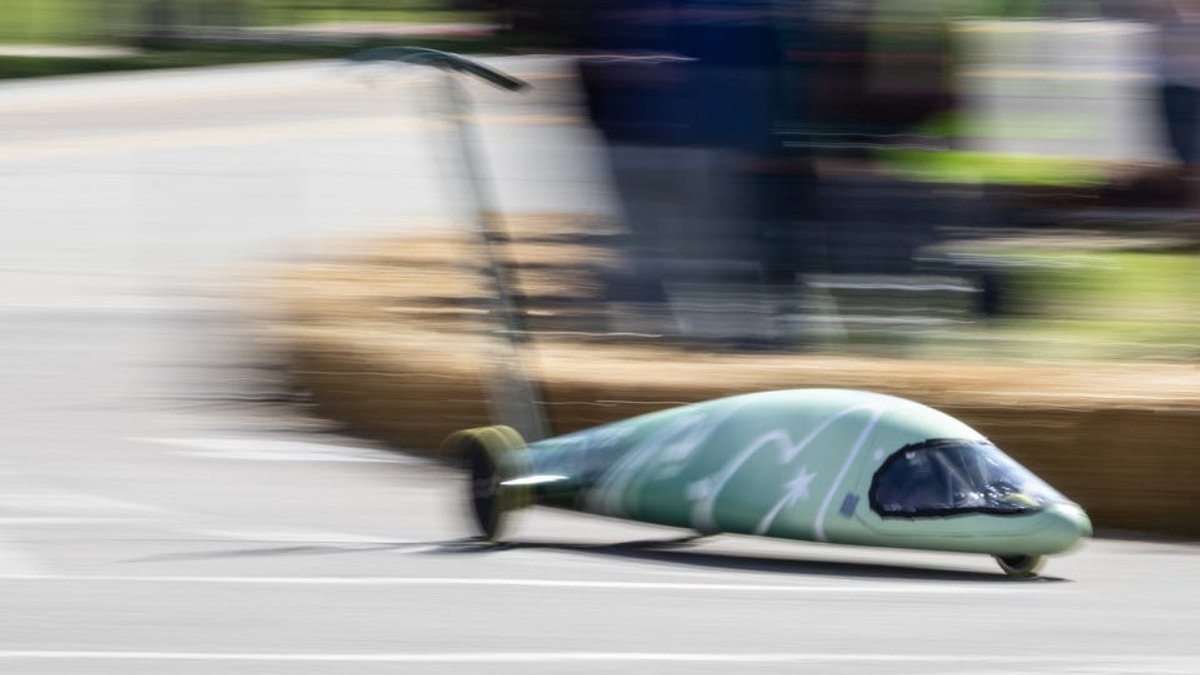
Carnegie Mellon University’s Buggy is a unique form of racing that has been taking place for over 100 years. Carnegie Mellon students engineer, build, and drive the vehicles that compete in this event, similar to Formula SAE. The competition involves a person inside a tube of carbon fiber, driven like a baton in a relay race.
Caroline Kiesnowski, the head mechanic and driver for a team, explains that the easiest way to describe Buggy is to put a person in a tube and use it as a baton in a relay race. The driver is pushed up two hills, does a free roll where they are completely in control, and then gets pushed back up three more hills to a finish line.
Competition and Design
The competition is incredibly competitive, with lots of teams vying for the win. Each team designs a new buggy every year, using experience from years past and new digital tools to refine the vehicle. The priorities are to have the smallest, lightest buggy possible for being pushed up the hill, and to design a buggy with the smallest coefficient of drag and wheels with minimal rolling resistance for the downhill sections.
Speeds top out around 40 miles per hour, and the students who pilot the buggies are highly recruited. Each team wants the smallest possible buggy, which means they need a small person to design the buggy’s body around. The design is centered around the driver, and the driver’s load into the buggy is a tight squeeze.
Course and Challenges
The course has one challenging turn called The Chute, which is the source of many crashes and spins. Students need to design their buggy around this turn every year. Two layouts are widely used: the standard trike and the reverse trike. The standard trike has two wheels in the rear and one in the front, while the reverse trike has two wheels up front and one in the rear.
Read Also: Porsche Boxster EV Mimics Flat-Six Engine Sound
Each layout has its pros and cons, but the standard trike is thought to be a bit dodgier in The Chute. The reverse trikes often use Ackermann-style steering, which increases complexity but is considered a better design for steering and braking. Kiesnowski finds the reverse trike design to be better for steering and braking.
Safety and Regulations
Safety is the number one goal in this competition, and drivers have helmets. There are regulations that teams have to follow in building their vehicles to ensure the sport is as safe as possible. The track is actually a road and is mighty bumpy, which adds to the challenge. Some teams have designed suspension to give the trike a better ride, but it’s a rare design choice that adds weight to a structure that’s trying to be kept as light as possible.
As with any good motorsports event, teams try to bend the rules and regulations for an advantage. Kiesnowski declined to offer details but said there have indeed been instances of teams looking for an advantage beyond the book. The competition takes place every April at Carnegie Mellon’s campus in Pittsburgh, Pennsylvania.
Windshield Restrictions, Bumpy Course and Passing Rules
Some teams install blacked-out, reflective windshields that prevent drivers from seeing the steering column. The course runs on a public road that is notoriously uneven and bumpy. Because of the rough surface, a few crews have experimented with adding suspension to smooth the ride. However, suspension adds extra mass, so it remains an uncommon choice for teams focused on lightness.
The downhill roll segment allows genuine wheel-to-wheel racing, with overtaking possible in that stretch. Safety remains the top priority, and every driver must wear a helmet during competition. Detailed regulations dictate vehicle construction standards to keep the sport as safe as possible. Organizers acknowledge that some teams have attempted to stretch those rules in pursuit of an edge.


